Deutsch
  Русский
  Español
  Italiano
  Français
  Portuguese
  Türkçe
  Ελληνικά
  >
>
How Much Does Mileage Affect Car Value?
It is an undeniable fact that car value and mileage are very closely related topics. Used car valuation data indicates that for every extra 10,000–15,000 miles beyond the average, value typically declines by around 5%–10%, all else being equal. The impacts are more obvious over the years. A 5-year-old car with 160,000 miles can sell for 20%–30% less than the same model with under 100,000 miles. However, such an impact is not solely based on objective facts; it has psychological reasons. As a vehicle exceeds average mileage, buyers typically expect a lower price to compensate for the increased wear and tear.
As it seems, mileage plays a crucial role along with age in evaluating a vehicle and calculating its depreciation rate. In the sections below, we break down how mileage affects car value, the role of 30/60/90 maintenance rules, and which car brands and models stand out for maintaining value even at higher mileage.
How much value does a car lose per mileage?
Percentage-based depreciation suggests that, on average, every 10,000 miles reduces the vehicle value by 5%-10%. At the same time, the first 20,000 miles benchmark is decisive, and it means 20% drop in value. Recent industry data confirms that moving from 10,000 miles to 20,000 miles is always impactful, as 24 % value drop is highly expected.
Authoritative sources such as Kelley Blue Book (vehicle valuation trends) and iSeeCars (large-scale depreciation studies) generally provides statistical data over 5 years.
Statistics provide general insights, for example, depreciation rates vary across different vehicle categories, with trucks and hybrids generally retaining value better than luxury and electric vehicles. Such data is useful for general understanding, but buyers and sellers often need a more precise picture supported by exact figures. For that reason, depreciation calculators and market-based valuation tools—widely available online—can help provide more accurate vehicle value estimates.
What is the “price you pay“ for mileage?
It seems that your mileage doesn’t count the same for different category vehicles. Additionally, it is impossible to state the exact percentage by which the automobile depreciates because mileage is never discussed in isolation. So, the only way to estimate this is to use calculators that take all factors such as category, age, brand, and market into consideration. The chart below represents such estimations for each category:
| Vehicle category | Value Loss per 10,000 Miles |
| Sports cars | 10% – 15% |
| Luxury Sedans | 8% – 12% |
| Electric Vehicles (EVs) | 7% – 10% |
| Japanese Sedans | 5% – 7% |
| Diesel Trucks | 3% – 5% |
What causes that car value loss:
- Sports/performance cars – It is evident that such automobiles experience significant value loss due to economic, mechanical, and buyer-attitude factors. These automobiles are designed for speed, acceleration, and aggressive driving. Hence, components such as brakes, tires, and suspension wear out faster than in other types of vehicles leading to higher maintenance expenses.
- Luxury Sedans – Luxurious sedans usually come with high ownership costs as they have expensive parts and constantly need specialized servicing. Such automobiles always come with advanced technology features, however, the point is that those features are time-sensitive and outdate quickly.
- Electric Vehicles (EVs) – as for EVs, the first concern is battery degradation problems, which lead to the necessity of replacing them, which costs a lot. On the other hand, the technology behind EVs evolves quickly, which means that older EVs are less appealing to buyers.
- Japanese Sedans (Toyota, Honda, Lexus) – These automobiles are known for their reliability and longevity, which means they are less sensitive to high mileage thresholds. Due to this, Market demand is always high, so, keeping the good vehicle value is not difficult for its owners.
- Diesel Trucks are known for their fascinating engine durability and less sensitivity to high mileage accumulation. Buyers pay less attention to their mileage levels, unlike other passenger cars.
Real-life calculation examples
Example 1: Economy (Japanese) Sedan – Daily driving
Original value: 26,000
Depreciation rate: 8% per 10,000 miles
The calculation: 26,000 * 0,08 = 2080
Conclusion: If you’re driving a reliable $26,000$ commuter car, expect to see its value dip by roughly $2,080$ for every $10,000$ miles you add to the odometer.
Example 2 : European Luxury SUV
Original value: 80,000
Depreciation rate: 12% per 10,000 miles
The calculation: 80,000*0,12 = 9600
Conclusion: Owners of an $80,000 premium SUV can see their resale value drop by as much as $9,600 for every 10,000 miles driven
What is the 30-60-90 rule for cars?
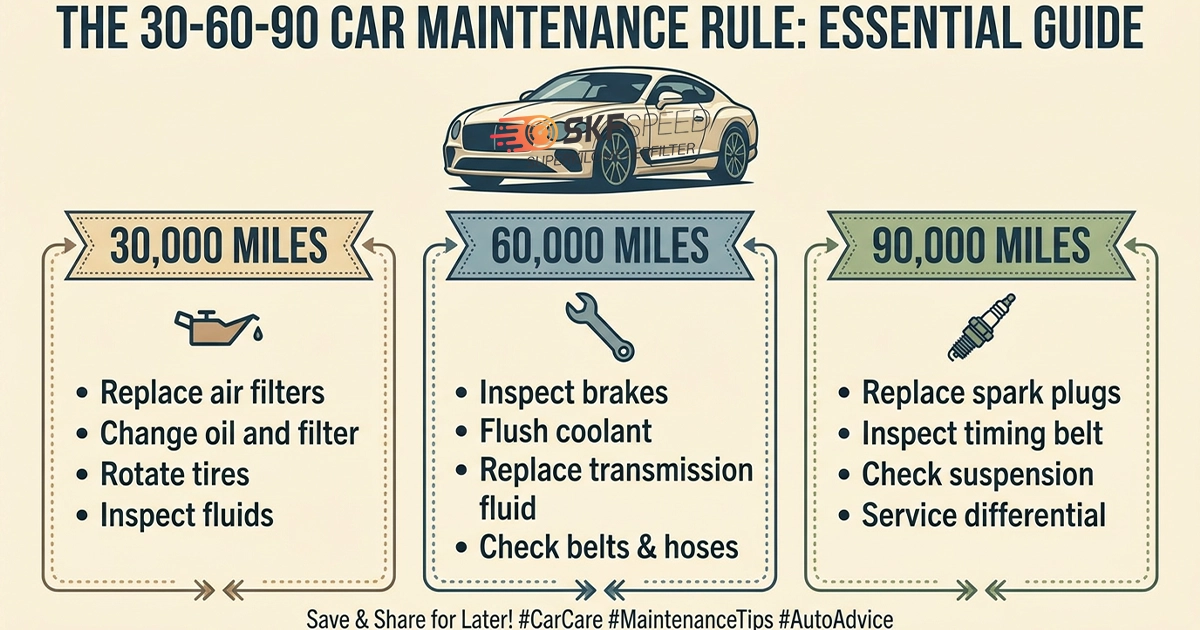
It is a widely known guideline that indicates that at 30,000, 60,000 and 90,000 mileage milestones, every automobile needs specific maintenance to keep running smoothly and preserve long-term car value. The rule suggests that instead of waiting for problems to arise, you follow a preventative maintenance routine that helps avoid major issues in the future. In the image below, you will learn what should be done at each mileage milestone:
High mileage vs poor maintenance: which is more harmful in the long run?
High-mileage automobiles aren’t a harmful choice; they are even better than low-mileage vehicles with poor maintenance. It is almost certain that poor maintenance is very terrifying for the well-being of the automobile. Some buyers tend to avoid vehicles with very high mileage or expect a significantly lower price to account for the increased wear and reduced remaining lifespan. In fact, it is a big mistake to discuss mileage in isolation. Whether such automobiles will be a good deal depends on the following: brand/model reliability, car category, age, and maintenance.
On the other hand, it doesn’t matter what other factors are when the automobile is poorly maintained all the time. If you don’t properly care for the automobile, it fails despite everything.
Top Reliable high-mileage car brands and models
Below is a list of car brands known for producing reliable, high-mileage vehicles that can reach close to 300,000 miles with minimal technical issues. Keeping vehicle value at the best level is possible with those brands. They remain long-standing consumer favorites and continue to experience steady demand on the market. Some brands have made history with impressive longevity records, while others have consistently remained customer favorites over the past decade. Note that this list is not ranked in any particular order.
- Honda – Honda is well known for producing reliable, high-mileage vehicles, with models like the Pilot, Ridgeline, and CR-V showing strong potential to exceed 200,000–250,000 miles. According to iSeeCars, the Honda Pilot stands out with a 42.7% chance of reaching 250,000+ miles—nearly four times the average—while models like the CR-V and Accord also significantly outperform typical longevity expectations.
- Toyota – Toyota is widely recognized for producing durable, high-mileage vehicles that can approach or exceed 250,000–300,000 miles, with models like the Sequoia and Land Cruiser leading longevity rankings. Toyota car value always stay exceptionally high.
- Lexus– Lexus stands out among luxury brands for combining reliability with strong high-mileage potential, with models like the GS 350 and ES 350 exceeding 200,000 miles. While Lexus vehicles are a smart used-car choice due to their durability and slower depreciation.
- Subaru – Subaru produces durable, all-wheel-drive vehicles that deliver strong performance and reliability across various driving conditions. Models like the Outback have a 22.3% chance of reaching over 250,000 miles—nearly twice the average—making Subaru a consistent contender among the best high-mileage cars.
You can learn more details about the topic in our previous blog.
In the following paragraph, we examine the key factors that most strongly influence a vehicle’s resale value.
What are the main factors affecting the vehicle price?
The following factors are those that shape overall vehicle value:
- Maintenance/service history;
- Brand reputation and model reliability;
- Age;
- Number of previous owners and accidents;
- Mileage;
- Market demand ;
- Vehicle category/type ;
- Fuel efficiency ;
- The existence of advanced features.
As you see, only one factor is not decisive; the behaviour of the potential buyer depends on all factors combined. Regarding these general factors, there can be subjective priorities and choices of the buyer which also affect the final decision (Geography, the usage pattern, budget, lifestyle, etc)
When we are talking about the past of the automobile, it is essential to investigate everything in more detail. For example, check the reliability of the odometer figures. Why did it become suspicious? Maybe the previous owner used a third-party tool, which affected the odometer. Sometimes it happens because of a performance test. One of the common and popular tools is Mileage Blocker, an exceptional tool that can halt the mileage recording process in all control units without leaving a trace.

Mileage blocker as one of the top testing tool on the market
Mileage blocker from SKF is an extraordinary tool that can be used in a controlled environment to stop the mileage recording process in all control units without leaving a trace. Most of the Mileage Blocker devices on the market filter mileage-related data from control units, but sometimes cause unforeseen flaws in the system. Mileage blocker from Super Kilometer Filter is not like this. You can be assured that the speedometer, tachometer (Tacho), and other systems will work without any interference.
You can purchase the tool directly from the SKF website for the model and maker you wish.
In short, the Mileage blocker tool has several advantages:
- DIY installation instruction;
- Mobile application for more convenience;
- Products assembled with high-quality components;
- Undetectable performance;
- Legal car testing possibility in a controlled environment ;
- Protection from unforeseen flaws in the system;
If you have additional questions regarding the device feel free to contact SKF support and customer service teams.
Takeaway
Car value is never determined by a single factor alone. Surely, mileage can tell us the hidden story behind the automobile; this story is never complete without considering other factors, such as age, previous accident, maintenance history, and many others. Keep it in mind when judging the condition of the automobile as a potential buyer.

By Maria Laskowski







Service center
CUSTOMER CENTER
Here you will find all the details about our company
Shipping and return
Here you will find shipping and return related information
Technical Support
Here you will find information on all technical questions
Installation Support
Here you will find helpful information about installation